

Featured Post
My favorite panc25 key field and horticultural crops done by the rating agency Crisil has indicated that per hectare profitability will improve 3-5% year-on-year to Rs. 10,0000 in the Kharif (Summer Crop) Season 2020.ake restaurant
However, economists say that individual farmers are unlikely to see any hike in their own income.
Key Points
Profits are Expected in the Agriculture Sector: Agriculture is one of the few bright spots in an economy ravaged by Covid-19, with good rains expected to boost production and profits, especially in the paddy crop.
To support farmers in effectively undertaking the post-harvest rabi produce and preparatory work for kharif crops, Rs. 30,000 crore additional emergency working capital fund through NABARD and Rs. 2 lakh crore of concessional credit have been provided by the government.
The agriculture sector showed growth of 5.9% in the last quarter of 2019-2020.
Impact on the Farmers’ Income: Some economists have opined that despite a hike in overall profits, per capita (per farmer) income may see a dip.
Reverse migration due to Covid-19 may have resulted in the number of people employed in the agriculture sector this summer rising by up to 16% over farm employment in 2019.
As per the data from the Centre for Monitoring Indian Economy (CMIE), the farm sector gained 14.9 million jobs in the April-July 2020 period.
Possible Reasons Behind Reduced Income of Farmers:
Reverse Migration: Because of the Covid lockdown, large numbers of people have gone back to rural areas, and apart from MGNREGA and agriculture, there is not any significant work.
Agriculture as an Employment Option: In general, people just migrate out of farming, mostly voluntarily, in search for better paying employment. But, people who can, do migrate into farming when they lose non-farming jobs.
CMIE data shows that 111.3 million people declared their occupation as farming in 2019-20. By March 2020, this had increased to 117 million, shooting up to 130 million in June.
Demand for Labour: Till the sowing season ends in August, there will remain demand for farm labour.
This means, even if there is an increase in farm profits, it will not help in reviving rural demand, as too many people are dependent on farm income this year.
Rise in Covid-19 cases in Rural India: There could be an adverse impact on harvesting and supply chains.
Decrease in the Prices of the Produce:
Whether growth in agricultural output also implies growth in the income of farmers depends on a lot of things. Most importantly, it depends on the prices received by farmers for the produce that they sell.
While cereal prices continue to show positive inflation, most other food groups, such as fruits and vegetables, eggs, poultry and fish, continue to see prices decline.
Further, with input prices also rising, most small and marginal farmers are likely to witness a decline in incomes rather than an increase.
Steps Taken by the Government:
The three ordinances introduced under the Atmanirbhar Bharat scheme in May 2020 – Farmers’ Produce Trade and Commerce (Promotion and Facilitation) Ordinance, Farmers (Empowerment and Protection) Agreement on Price Assurance and Farm Services Ordinance and the Essential Commodities (Amendment) Ordinance – will give the farmers the benefit of ‘my crop, my right’ and help them gain higher prices for their produce.
Launch of Agriculture Infrastructure Fund of Rs.1 lakh crore by the Prime Minister for setting up cold chains, refrigerated transportation, etc. will help farmers command better prices.
These structural reforms will go a long way in reviving India’s rural ecosystem.
Way Forward
Initiatives undertaken by MNCs such as ‘e-choupal’ by ITC Limited which enables rural India with technical know-how for an effective agri ecosystem and facilitates transparent mechanism for price discovery should be encouraged.
Government should consolidate and leverage the CSC (Common Service Center) pan India network. It should also focus on promoting cottage industries, provide better amenities in terms of health care,
education, road network, communication and power so that the rural population can also be in a position to access quality life on par with the urban sector. This will also lessen migration towards cities in search of job opportunities.
Latest Posts
what is eNAM
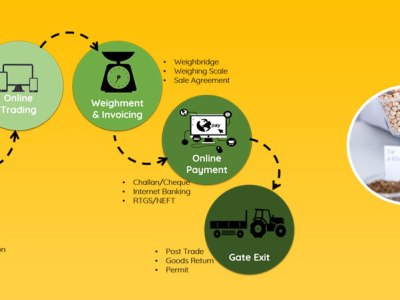
National Agriculture Market (eNAM) is a pan-India electronic trading portal which networks the existing APMC mandis to create a unified national market for agricultural commodities. Small Farmers Agribusiness Consortium (SFAC) is the lead agency for implementing eNAM under the aegis of Ministry of Agriculture and Farmers’ Welfare, Government of India.

about Us
we are team of highly driven new generation peoples who are intrigued by general science, geography, environmental & agricultural issues of India and are interested to share the new technologies, information about these sectors to all our readers… keep reading, keep growing.
Follow Me
Get new content delivered directly to your inbox.
 economically